
Photo Essay / March 2026

장소 이면의 장소
모뉴먼트 지하철역에 내렸다.
출근 시간이라 사람들로 붐볐다. 텀블러를 들고 검정 코트를 입은 여성이 구두 소리를 내며 어깨를 스치고 지나갔다. 형광 조끼를 걸친 청소원들이 길가를 정리하고 있다.
모두 자신이 맡은 자리와 시간을 향해 분주히 움직였다. 나도 한때 이 시간 런던에서 바삐 움직이며 산 적이 있다. 몇 년간 내쉬었던 나의 숨은 도시의 유령처럼 골목 어딘가에 배어 있을까.
호텔에서 보았던 지도를 떠올리며 빨간 버스가 다니는 길가를 걸었다. 외워 두었던 골목 이름이 나왔다. 경사진 돌길로 내려갔다. 울창한 수목이 보였다. 회색 석조 건물 폐허가 나무와 엉켜 있다. 던스턴 교회다. 중세에 지은 교회는 세계대전 런던 공습 때 파괴되었다. 돌을 쌓아 만든 벽과 첨탑만 남고, 지붕과 나머지는 사라졌다. 초록 이끼가 돌 표면에 잔뜩 끼었다. 오랜 세월이 만든 색과 질감이 깊고 그윽했다.
안으로 들어갔다. 하늘로 열렸다. 내부에 크고 작은 나무가 자라고 있다. 안으로 들어갔는데 밖이고, 내부인 줄 알았는데 외부였다. 한때 교회라고 불린 곳. 지금 이곳은 무엇일까. 마치 건축으로 화두를 받은 느낌이었다. 모순된 논리의 선불교 화두. 받으면 턱 하고 말문이 막히고 생각이 멈추는 화두. 교회, 정원, 안, 밖, 내부, 외부… 기억 속 언어가 경계를 잃고 흐릿한 안개처럼 흩어졌다. 더 이상 세상을 규정짓지 못하고 힘을 잃었다. 대신 그저 있음의, 그저 존재함의 순간이 살아났다. 새벽 비가 축축하게 밴 돌 냄새, 골목 사이를 지나며 나뭇잎과 얼굴을 스치는 바람, 정적을 가르는 새 소리. 이름 붙일 수 없는 침묵의 공명이 허공에 감돌았다.
주변 건물이 보였다. 언어로, 수치로, 수익으로 규정되고 경계 지은 셀 수 없는 공간들… 저곳들도 언젠가 지붕과 창이 사라지면 벽과 듬성듬성 뚫어진 구멍으로 빛과 바람과 소리만 흐를 것이다. 아니 지금 이 순간에도 기능과 효율의 공간 이면에는 알 수 없는 침묵이 흐르고 있다. 탕비실에서 커피가 내려지는 동안 초점을 잃고 바닥을 응시하는 누군가의 마음도, 검정 코트를 걸어 놓고 컴퓨터를 켜며 창밖을 바라보는 그녀의 마음도 잠시 언어의 공간과 시간을 벗어나 있을지 모른다.
언어와 침묵은 서로의 반대가 아니다. 언어는 침묵 안에 놓인다.
도시의 한 폐허가 장소 이면의 장소로 들어가게 한다.
The Place Beyond Place
I got off at Monument Station.
It was crowded with commuters. A woman in a black coat holding a tumbler brushed past me, her heels clicking sharply. Workers in fluorescent vests were tidying the street.
Everyone moved busily toward their assigned places and hours. I, too, once lived in London, moving through these same hours. Does the breath I exhaled during those years linger somewhere in the alleys, like a ghost of the city?
Recalling the map I had seen at the hotel, I walked along the street where red buses passed. A memorized alley name appeared. I went down a sloping stone path. Dense trees came into view. The gray stone ruins of a building were entangled with the foliage. It was St Dunstan-in-the-East. The medieval church had been destroyed during the London Blitz. Only the stone walls and the spire remained; the roof and everything else had vanished. Green moss thickly covered the stone surfaces. The colors and textures shaped by long years felt deep and subdued.
I stepped inside. It opened to the sky. Trees of various sizes were growing within. I had entered inside, yet it was outside. What I thought was interior revealed itself as exterior. A place once called a church — what is it now? It felt as if I had been given a koan through architecture. A Zen koan of contradictory logic: once received, it strikes and leaves one speechless, thought suspended. Church, garden, inside, outside, interior, exterior… The language stored in memory lost its boundaries and dispersed like a faint mist. It could no longer define the world and lost its force. In its place, a moment of simple being, of mere existence came alive. The damp scent of stone soaked with early morning rain, the wind passing through the alley brushing leaves and my face, the sound of birds cutting through the stillness. A resonance of silence, impossible to name, hovered in the air.
The surrounding buildings came into view — countless spaces defined and demarcated by language, numbers, and profit. Someday, when the roofs and windows disappear, only light, wind, and sound will flow through the walls and scattered openings. No, perhaps even now, behind spaces of function and efficiency, an unknowable silence is already flowing. While coffee drips in the pantry, someone staring absentmindedly at the floor, while the woman who hanged her black coat turns on her computer and gazes out the window, perhaps their minds too slip for a moment beyond the space and time of language.
Language and silence are not opposites. Language lies within silence.
A ruin in the city leads us into the place beyond place.
Photo : St Dunstan-in-the-East / by Jong-Jin Kim
Photo Essay / February 2026
빛의 목소리
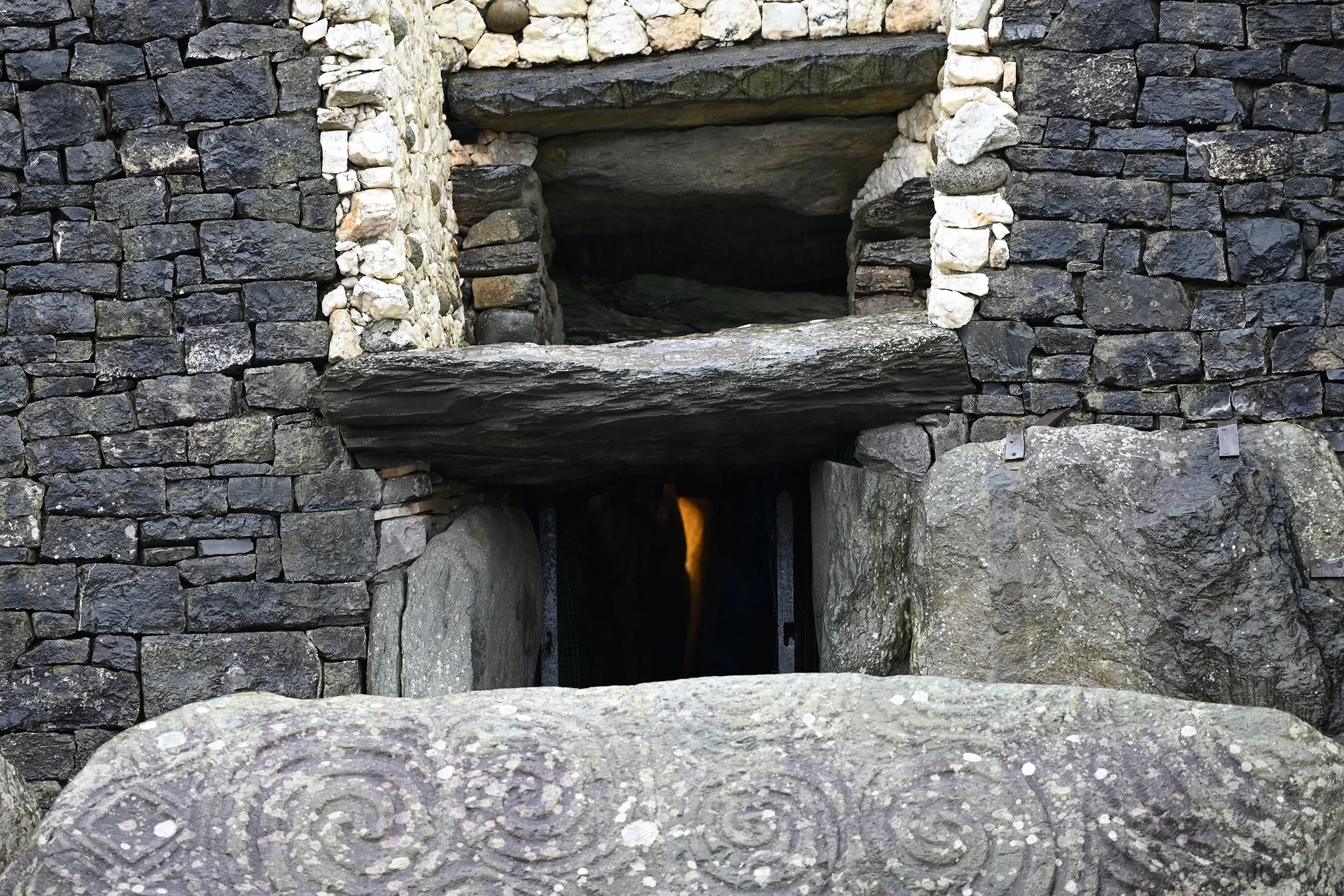
좁은 통로로 들어갔다. 한 사람이 겨우 지나는 폭. 고개를 숙이고 양손으로 돌벽을 쓸며 어둠을 향해 나아갔다. 통로 끝이 열리며 동그란 공간이 나타났다. 머리 위는 돌을 겹쳐 쌓아 만든 돔 천장이었다. 곳곳에 나선 문양이 새겨져 있다.
고고학 가이드가 설명하는 동안, 나는 손으로 허리 뒤 바위를 쓰다듬었다. 차갑고 거친 돌 표면에서 5000년 전 손길이 느껴졌다. 가이드가 내부를 밝혔던 조명을 껐다. 암흑으로 변했다. 검은 허공이 무한히 펼쳐졌다. 수천 년 전 영혼이 옆에 있는 것 같았다. 그가 말을 걸었다.
입구 쪽에서부터 두 뼘 정도 폭의 노란 빛이 들어왔다. 긴 한 줄기 빛이 바닥에 맺혔다. 빛은 점점 밝아졌다. 통로 끝까지 들어온 빛은 사람들과 원형 공간을 오렌지빛으로 물들였다. 동짓날 빛 현상을 인공조명으로 재현한 것이다.
석기시대 아일랜드인들은 이 한 줄기 빛을 끌어들이기 위해, 지름 80미터에 달하는 봉분을 지었다. 매년 12월 21일 일출을 위해, 단 17분의 빛을 위해 거대한 신전을 만들었다. 1년 중 해가 가장 짧은 날, 동지. 이날 이후로 낮은 다시 길어진다. 아득히 먼 옛날, 밤은 죽음이자 두려움이었다. 그들에게 동지 일출은 새로운 삶의 시작이었다.
이집트 카르나크, 페루 잉카 유적도 모두 동짓날 일출 빛을 정교하게 안으로 끌어들인다. 그렇게 ‘그 순간'이 창조된다. 사람과 세계는 다시 태어난다.
우리는 ‘시 안 브루’(Sí an Bhrú. 브루의 요정 언덕. 영어명: 뉴그레인지)의 탄생 이유를 정확히 알 수 없다. 종교, 예술, 정치 같은 후대 개념으로 섣불리 규정하면 안 된다. 그런 개념이 있기 전, 문자 언어조차 존재하지 않던 시절에 생겼기 때문이다. 순수한 마음으로, 그들의 심장으로 이곳을 대해야 한다.
그런데도, 변치 않는 진실이 있다. 고대인들은 혼돈된 세상 속에서 우주의 시간과 공간 질서를 발견했고, 그것을 구조화했다는 점이다. 그리고 오천 년 세월 동안 매해 동짓날 아침 8시 45분에는 한줄기 태양 빛이 들어오고, 우리의 몸과 영혼을 깊게 물들인다는 점이다.
오렌지빛으로 깨어난, 검은 허공이 말을 건다.
Voice of Light
I entered a narrow passage, barely wide enough for one person. I bowed my head and, with both hands, traced the stone walls as I moved toward the darkness. The passage opened onto a circular chamber. Above me, a dome ceiling rose, built of stones stacked one upon another. Spiral carvings were etched throughout.
While the archaeological guide spoke, I reached behind my waist and stroked the rock. On its cold, rough surface, I felt the touch of hands from five thousand years ago. Then the guide switched off the lights that had illuminated the interior. Darkness fell. A black void stretched into infinity. It felt as though a spirit from millennia past stood beside me. He spoke.
From the direction of the entrance, a band of yellow light—no wider than two palms—slipped in. A long, slender beam settled on the floor. The light grew steadily brighter. As it reached the end of the passage, it washed the people and the circular chamber in orange. This was an artificial reenactment of the solstice light.
To draw in this single beam, Stone Age inhabitants of Ireland built a mound eighty meters in diameter. For the sunrise of December 21—for just seventeen minutes of light—they raised a vast sanctuary. On the winter solstice, the shortest day of the year, daylight begins to lengthen again. In that distant past, night was death and fear. For them, the solstice sunrise marked the beginning of new life.
Karnak in Egypt and Inca sites in Peru also draw the solstice sunrise precisely into their depths. Thus, that moment is created. Human beings and the world are reborn.
We cannot know with certainty why Sí an Bhrú—the fairy mound of Brú, known in English as Newgrange—came into being. We must not hastily define it using later concepts such as religion, art, or politics. Those ideas did not yet exist; even written language had not been born. We must approach this place with a pure mind, with their hearts.
Even so, one truth remains unchanged. Ancient people discovered order in the universe’s time and space amid a chaotic world, and they gave that order structure. And for five thousand years, every winter solstice morning at 8:45, a single ray of sunlight enters and deeply stains our bodies and souls.
The black void, awakened in orange, speaks.
Photo : Entrance of Sí an Bhrú / by Jong-Jin Kim
Photo Essay / January 2026
바흐의 보이지 않는 건축
아주 오랜만에 다시 피아노를 치기 시작했다. 요한 세바스찬 바흐의 인벤션을 배우는 중이다. 문득 바흐의 음악과 황금비례 사이 관계가 궁금해졌다. 간혹 회자되는 내용인데, 실제로 그런지 확인해보고 싶었다.
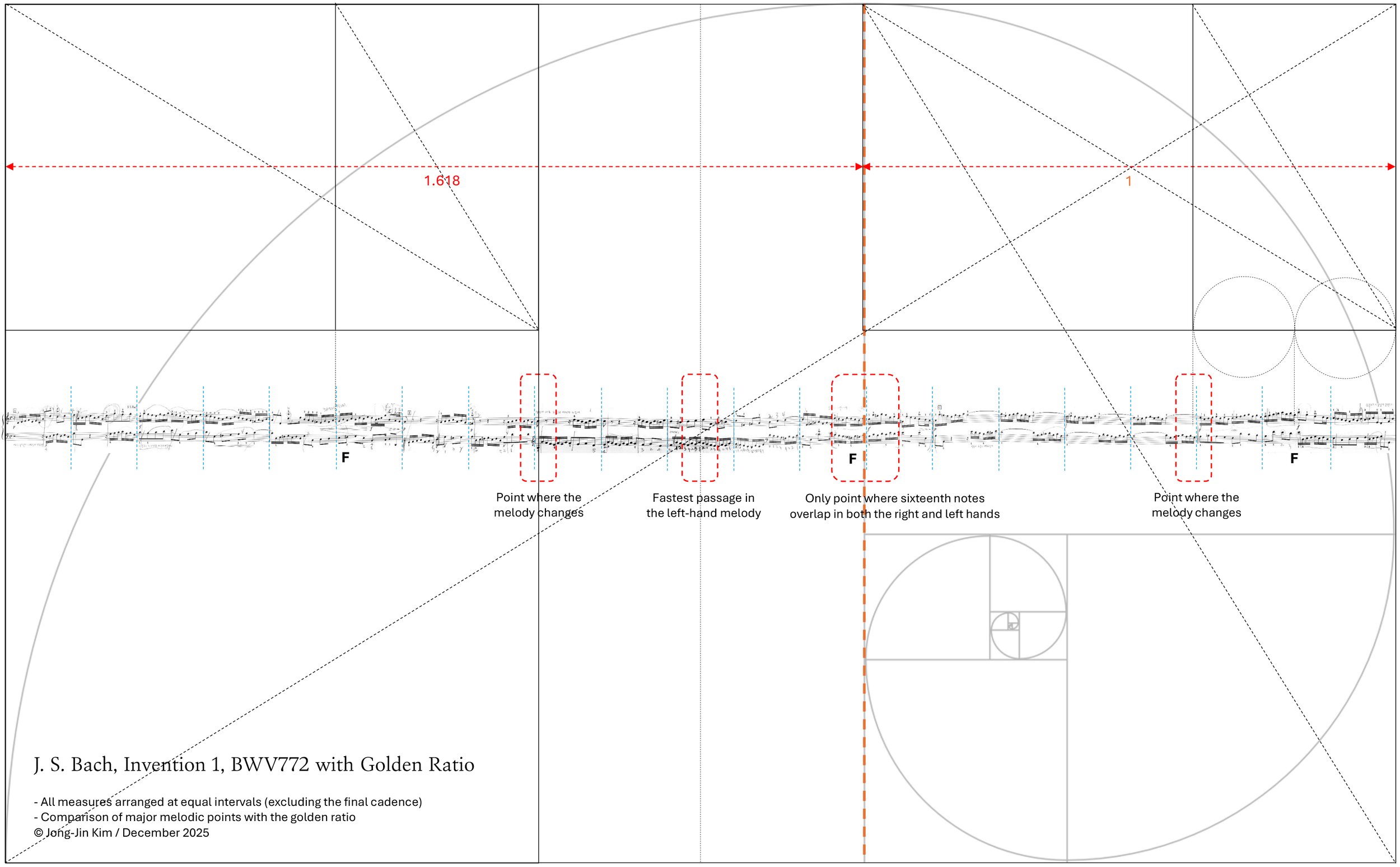
인벤션 1번 곡 22마디를 직선으로 길게 이어붙였다. 그리고 1:1.618 비례를 가지는 황금비율 사각형을 겹쳐 보았다. 놀랍게도 몇몇 중요 지점이 황금비례 질서와 정확히 맞아 떨어진다. 특히 곡의 절정부인 13-14마디가 황금비 지점과 일치한다. 이곳은 유일하게 오른손과 왼손이 모두 16분음표로 겹치는 부분이다. 선율이 바뀌거나 강조하는 다른 지점 역시 더 작은 황금비 구조 안에 놓인다.
과연 바흐는 의도적으로 이 모든 것을 설계했을까? 그가 황금비례를 사용했다는 기록은 전하지 않는다. 하지만 대위법을 비롯한 여러 작곡기법을 통해 조화로운 질서를 추구했다는 사실은 분명하다. 악보가 시각적으로 황금비례와 일치하는 것과 청각적으로 그것을 경험하는 것은 다른 차원의 이야기다. 눈으로 볼 때는 전체구조가 한번에 파악되지만, 귀로 들을 때는 시간 흐름 속에서 앞뒤 소리를 기억하며 비례를 느끼거나 추론해야 한다. 무의식적으로 비례를 체험할 수도 있다.
바흐의 음악은 수학적 질서와 구조적 조화를 갖춘 건축물 같다. 특히 돌과 벽돌을 정교하게 쌓아 올린 석조 건축 같다. 그 질서와 조화는 아름다운 선율과 화음으로 건축의 공간과 우리의 마음을 파고든다. 그 건축은 눈에 보이지 않는다. 들리는 건축이다. 경험하는 순간 사라져버리는, 깊은 여운을 남긴채 허공 속으로 흩어져버리는. 그래서 더욱 매혹적이다.
Bach’s Invisible Architecture
After a very long time, I have started playing the piano again. These days, I am practicing Johann Sebastian Bach’s Inventions. At some point, I became curious about the relationship between Bach’s music and the golden ratio. This idea is occasionally mentioned, but I wanted to verify it for myself.
I took Invention No. 1, which consists of 22 measures, and laid it out as a single continuous line. Then I overlaid a golden-ratio rectangle with a proportion of 1:1.618. Surprisingly, several key moments aligned precisely with the order of the golden ratio. In particular, the climax of the piece - measures 13~14 - coincides exactly with the golden-ratio point. This is the only passage where the right and left hands overlap entirely in sixteenth notes. Other moments where the melody shifts or emphasis is required are also situated within smaller golden-ratio structures.
Did Bach consciously design all of this? There is no record indicating that he deliberately applied the golden ratio. Yet it is undeniable that, through counterpoint and many other composition techniques, he pursued harmonious order. The visual correspondence between the score and the golden ratio, however, belongs to a different dimension from the way we experience the music aurally. With our eyes, we grasp the overall structure at once. With our ears, we perceive proportion only through the flow of time, by remembering what came before and anticipating what follows. Sometimes, this sense of proportion may be experienced unconsciously.
Bach’s music resembles architecture endowed with mathematical order and structural harmony. In particular, it feels like stone architecture, meticulously assembled through the precise layering of stone and brick. That order and harmony permeate architectural space and our minds through beautiful melody and harmony. His architecture is invisible. It is architecture that is heard. It vanishes the moment it is experienced, scattering into the air while leaving a deep lingering resonance behind. That is precisely what makes it all the more captivating.
Diagram by Jong-Jin Kim